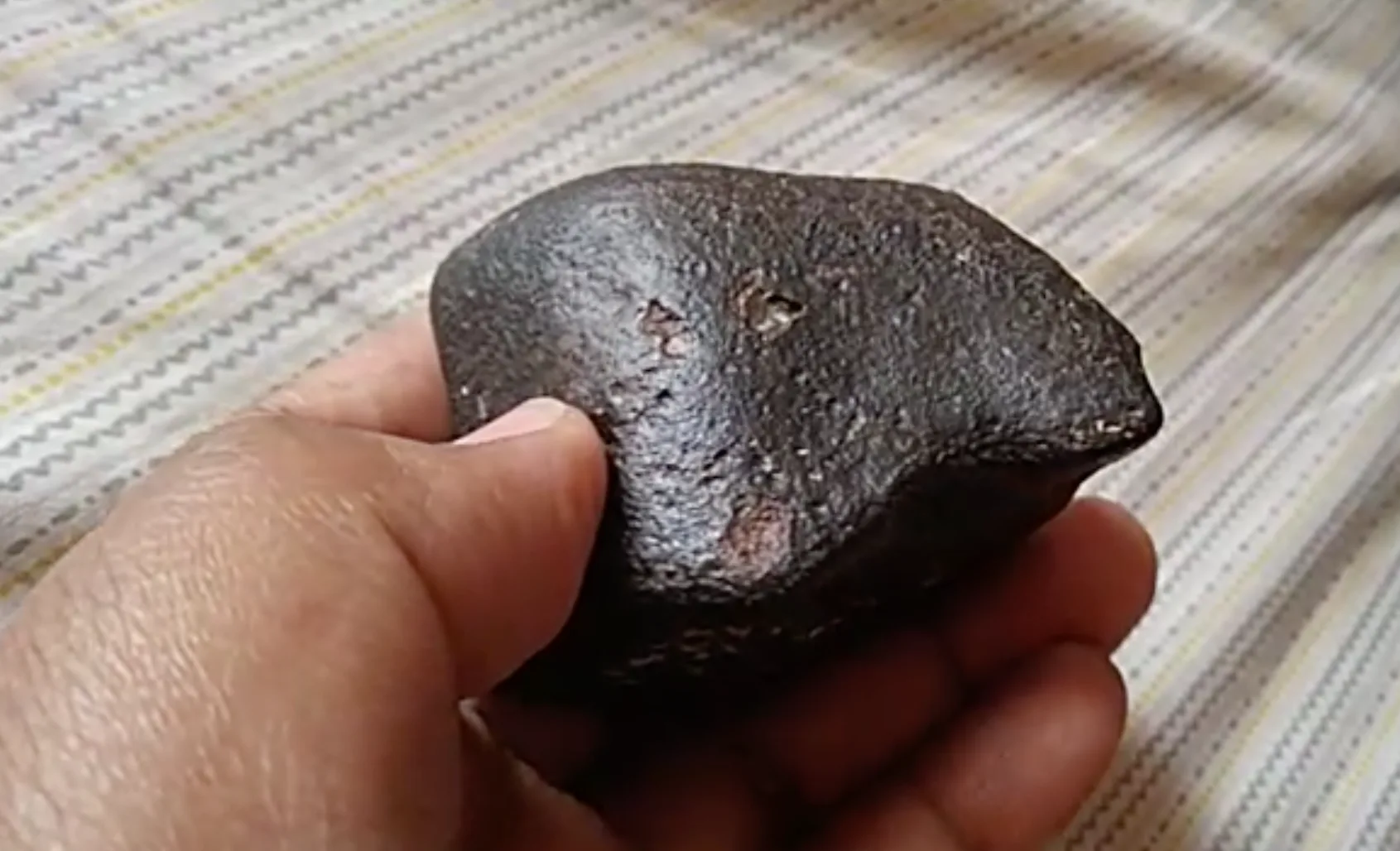
Let me tell you about the meteorite.
I was living in Santiago for a year, as part of a startup programme. Chile is a long, improbable country with everything from glaciers to deserts, and at the northern end of it sits the Atacama - one of the driest places on Earth. Meteorites fall everywhere at roughly the same rate, but in most places they get buried, eroded, overgrown, or picked up. In the Atacama, they just sit on the surface. For thousands of years, sometimes longer. Dark rocks on pale ground, waiting for someone to notice them.
It was too good an opportunity to pass up. But how do you go about it in a different country, with a language barrier and limited resources, in a desert with no roads, no water, and where getting lost could prove fatal?
The Plan
I did what any coder would do.
I found the Meteoritical Bulletin - a public database that records every documented meteorite recovery on Earth, with coordinates. I scraped the Chilean entries, extracted the latitude-longitude pairs, and overlaid them as pins on a custom Google Map.
Meteorites break up during descent and fall in clusters called strewn fields, so searching near a known recovery is a good strategy - you are at least in the right neighbourhood, and there may be fragments that nobody picked up. I tried to figure out which of those strewn fields were accessible a short walk from known trails in the desert, and which of those trails were near a town. The overlap was small, but it existed.
I had a target.
Calama
I went shopping. A compass. A stick. A few powerful neodymium magnets - meteorites contain iron and nickel, so a strong magnet is the simplest field test. Then I put together a survival backpack: warm clothes, some high-calorie food, and as much water as I could carry.
I was not intending to die for this hobby.
I booked the closest Airbnb to my target location, got on a bus, and arrived in Calama. A town where it had not rained in four hundred years.
The Expedition
My friend Ajit came with me. First problem: we needed a vehicle. The Atacama is not a place you walk into from a bus stop. We went around town trying to rent something for our "expedition", but the regular car rentals took one look at two guys who clearly did not know the desert and refused.
Out of options, we told our story to the Airbnb owner, hoping she might have some contacts. To our joy and surprise, she herself volunteered. She said it was a crazy story, be ready tomorrow morning, she would take these two crazy Indian boys. Just pay for the petrol.
Come morning, guess what vehicle she rolls up in.
A Mahindra Scorpio.
Of all things. Turns out Bajaj Pulsar and Mahindra Scorpio were well-selling vehicles in South America. There is something deeply surreal about climbing into a Scorpio in the Chilean desert, but there we were.
Off we went, the three of us, putting our trust in Google Maps and the little coloured pins I had placed on it. Soon we left civilisation behind. The roads turned into paths and the paths turned into dust trails, which themselves soon vanished, and we were on our own in one of the most isolated places in the world.
And then, a flat tyre.
The Search
Right. We are city boys, but both engineers after all. How hard can it be?
Opened up the back, found the spare, found the jack. The ground was soft sand and the jack would not sit straight, so we spent ten minutes digging around for flat rocks to put under it. Ajit held the car steady while I cranked the jack, and our host watched with the calm expression of someone who had seen worse. Twenty minutes of grunting and dust later, we had a spare on and three filthy people feeling unreasonably proud of themselves.
We kept driving.
The pins on my map eventually brought us to a wide, flat stretch of pale brown nothing. This was it - or at least, this was where the database said someone had once found a rock from space. We got out, spread apart, and started walking. Slowly. Eyes on the ground.
The method is simple. You look for rocks that do not match the surrounding terrain - darker, heavier, with a distinctive glassy surface from atmospheric entry. You test anything promising with a magnet. Meteorites stick. Everything else does not.
For the first thirty minutes I was excited. Every dark rock was a candidate. My heart rate would spike, I would crouch down, press the magnet to the surface, feel nothing. Volcanic basalt. Move on. By the second hour I had tested fifty rocks and found fifty disappointments, and I started to wonder whether I had in fact scraped a database, convinced a Chilean woman to lend us her Scorpio, and driven into one of the most inhospitable places on Earth to pick up ordinary stones.
Our host sat on the bonnet and watched us crawl around the desert like very determined ants. I suspect she was enjoying herself.
The Rock
And then I picked up a stone.
Small - maybe the size of a large walnut. Jet black, heavier than it looked. I pressed the magnet to it and it snapped to the surface like it had been waiting. I pressed another magnet to a different face. Same result. The surface had a thin, glassy crust with fine thumbprint-like impressions - regmaglypts, formed by ablation during atmospheric entry.
I called Ajit over. We tested it again. And again. We put it in a ziplock bag. We kept searching for another hour, found nothing else that stuck, and drove back to Calama sunburnt, dehydrated, and grinning like idiots.
I later had the rock examined. It was a chondrite - an ordinary chondrite, the most common type of stony meteorite, but no less extraordinary for that. Roughly four and a half billion years old. It had been sitting in the Atacama for thousands of years before a coder in a startup programme scraped a database, convinced an Airbnb owner to drive him into the desert in a Scorpio, changed a flat tyre on soft sand, and picked it up with a magnet on a stick.
I still have it on my desk. A small dark stone that looks like nothing much, unless you know what it is.